|
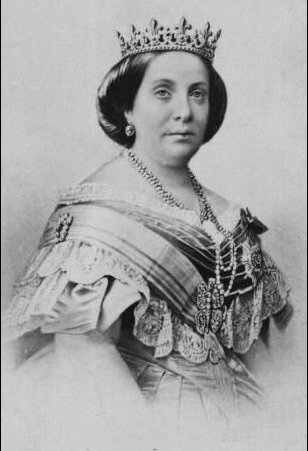
 Isabella was born in Madrid on October 10, 1830. She was the
eldest daughter of King Ferdinand VII and of his fourth wife, Maria Cristina,
a Neapolitan Bourbon. Maria Cristina became Queen-Regent on September 29,
1833, when her daughter Isabella, at the age of three years, was proclaimed
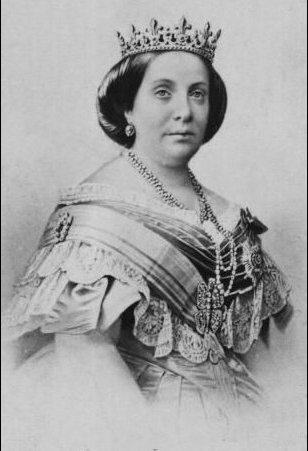
queen on the death of her father. Isabella was born in Madrid on October 10, 1830. She was the
eldest daughter of King Ferdinand VII and of his fourth wife, Maria Cristina,
a Neapolitan Bourbon. Maria Cristina became Queen-Regent on September 29,
1833, when her daughter Isabella, at the age of three years, was proclaimed
queen on the death of her father.
Queen Isabella II succeeded to the
throne as a result of King Ferdinand VII inducing the Spanish Cortes to
assist him in setting aside the Spanish Salic law of Philip V, introduced by
the Bourbons in the early 18th century, which declared that only the male
line should succeed to the Spanish throne. Instead, he convinced the Spanish
Cortes to re-establish the older succession law of Spain, allowing Isabella II
rightful succession to the throne.
This change meant that Carlos V, the
brother of King Ferdinand VII, was denounced as king and became the
Pretender. Don Carlos disputed Isabella's right to succeed to the throne and
her accession precipitated seven years of civil war. During this time, Don
Carlos, with the help of the Holy See, Austria,
Russia, Prussia and the Italian Kingdoms
organized a coalition aimed at seizing power. Civil war dragged on until
August 31, 1839, when the Agreement of Vergara, ratified between General
Baldomero Esparto and the Carlist General Rafael Maroto was put into effect,
whereby Isabella II was recognised as Queen of Spain.
Isabella’s rights were only maintained
through the support of the army, the Cortes and the Liberals and
Progressists, who at the same time established constitutional and
parliamentary government, dissolved the religious orders, confiscated the
property of the orders including the Jesuits, and attempted to restore order
in finances.
Maria Cristina remained Queen-Regent
until a secret marriage to an ex-sergeant from the royal guard, Don Fernando
Muñoz, which took place on December 28, 1833, shortly after the death of the
king, became public knowledge. The Queen-Regent’s position was undermined by
news of her re-marriage and concerns that Maria Cristina was not actually
supportive of her liberal ministers and their policies. Eventually, the army,
which was the backbone of Isabella II’s support, and the liberal leadership
in the Cortes combined to demand that Maria Cristina stand aside from her
Regency, where she was forced to leave Spain. On October 12, 1840, the
most successful and most popular general of the Isabelline armies, General
Baldomero Espartero, replaced her as Regent.
A military revolt was instigated by
Maria Cristina from exile in Paris, supported
by noted generals started on September 27, 1841 and continued with a serious
rebellion a year later with bombardment of Barcelona. In May 1843, Espartero was
turned out by a military and political pronunciamiento, led by Generals Leopoldo
O’Donnell and Ramón María Narvaez, who formed a cabinet, presided over by
Joaquin Maria Lopez. This government induced the Cortes to declare Isabella,
who at the time was thirteen, of age to rule Spain. On November 10, 1843, she
swore loyalty to the Constitution and began her personal rule as Queen
Isabella II. After an unsuccessful attempt to return to power, Maria Cristina
retired permanently to exile in France after 1844.
The Queen, at age sixteen, was married
on October 10, 1846 to her cousin, Francisco de Asis de Borbon (Duke of
Cadiz), then twenty-four years of age. The King Consort was not of Isabella’s
own choice nor her liking and in fact lived mainly separate from him. The
Queen was believed to have had a constant string of lovers, most notably her
Prime Ministers.
The period of Isabella's personal rule
(1843-1868) was characterized by political unrest and a series of uprisings.
She showed most favour to her reactionary generals and statesmen, to the
Church and religious orders, and was constantly the tool of corrupt and
profligate courtiers and favourites who gave her Court a bad name. Her
government was dominated by military politicians, most notably General Ramón
María Narváez and the somewhat more liberal General Leopoldo O'Donnell.
Liberal opposition to the regime's authoritarianism became increasingly
directed at the Queen. Scandalous reports on the private conduct of Isabella,
as well as her arbitrary political interference, further damaged the
monarchical cause. The abortive uprising of 1866, and the deaths of O'Donnell
(1867) and Narváez (1868), weakened her position further, and gave wide
support to the military rising against Isabella. Her Moderado generals had
made a slight show of resistance that was crushed at the battle of Alcolea by
Marshals Serrano and Prim. On September 30, 1868, at the age of thirty-seven,
Isabella was forced from her throne and joined her mother in exile in France.
Isabella was persuaded to abdicate her
throne in Paris
on June 25, 1870 in favour of her eldest surviving son, Alfonso XII. She
returned to Spain for a
time after King Alfonso XII's accession in 1874 but was unsuccessful in
influencing political affairs, returning to Paris,
where she resided for the rest of her life, seldom travelling abroad except
for a few visits to Spain.
During her exile she grew closer to her husband, with whom she maintained an
ambiguous friendship until his death in 1902. She died on April 10, 1904,
aged seventy-three, and is entombed in El Escorial in Madrid.
|